The Challenge
Preparing a credit note for a corporate loan means pulling financial filings from the Ministry of Corporate Affairs, tax records from ITR and GST databases, director background checks, and a live credit bureau pull — then reconciling all of it into a single narrative with a risk assessment attached. Each of those sources lives in a different system, with its own login, its own format, and its own quirks.
Analysts do this by hand today: open five or six portals, copy figures into a template, write the risk narrative themselves, and hope nothing was mistyped along the way. It takes days per note, the quality depends on which analyst wrote it, and there is no consistent audit trail showing where each number came from.
“A credit note that pulls from six disconnected systems isn't a summarization problem — it's an orchestration problem. That's why this runs as an agent, not a chat window.”
The Solution
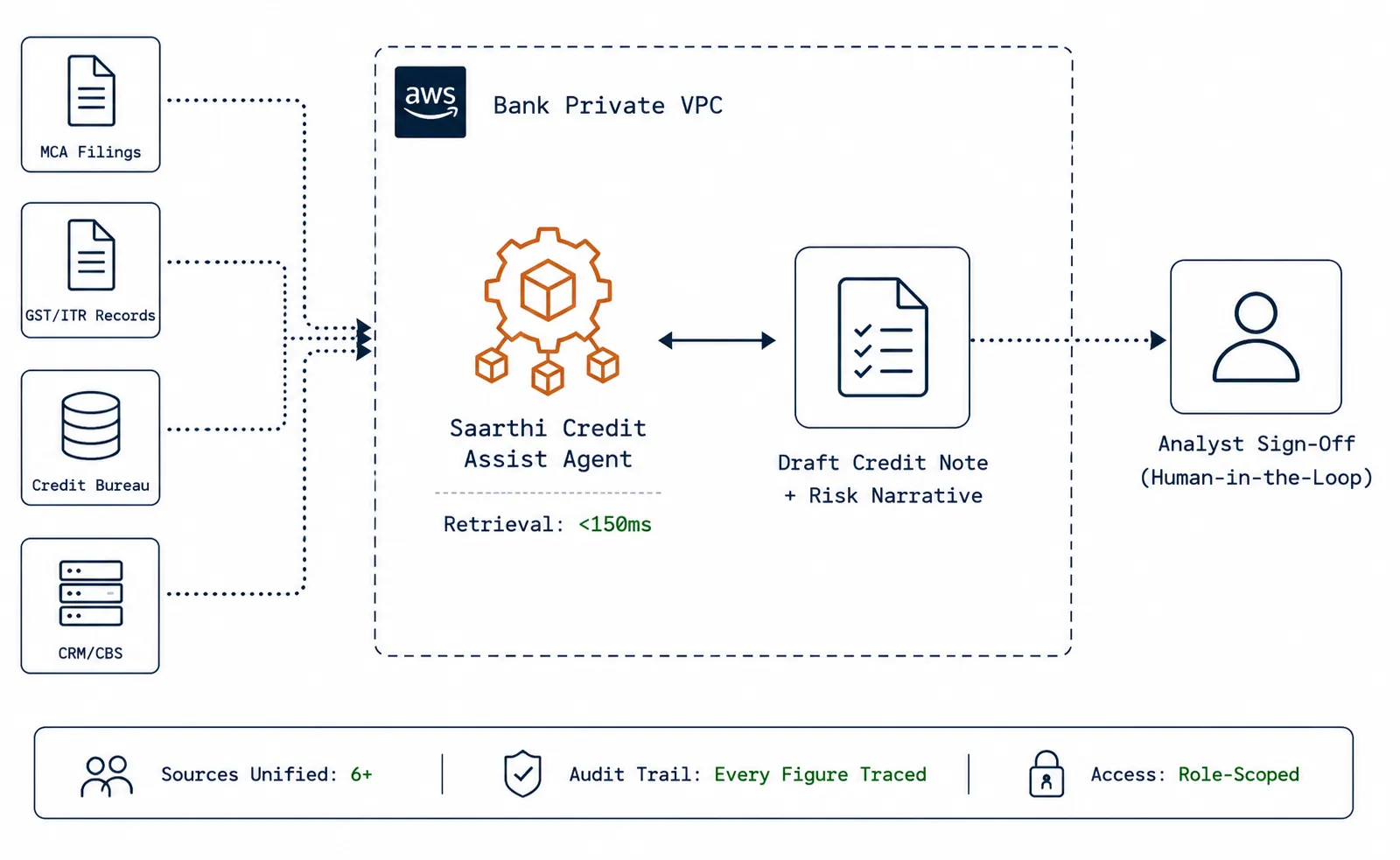
This is what the Saarthi Credit Assist Agent is built for. It connects to each statutory and bureau source directly, pulls the relevant figures for a given borrower, and cross-checks them against each other — flagging cases where, say, the financials filed with MCA don't line up with what the borrower submitted. It drafts the credit note and risk narrative from that reconciled data, and routes anything genuinely ambiguous to a human analyst for sign-off rather than guessing.
The reason this needs to be an agent and not a single prompt is the shape of the problem: it's not "summarize this document," it's "go get data from six independent systems, notice when they disagree, and decide what to do about it." That requires making tool calls, evaluating what comes back, and branching — retry a source, flag a mismatch, or proceed — which is exactly what an autonomous agent does and a one-shot LLM call cannot.
What This Pattern Typically Delivers
Because the underlying retrieval runs on Saarthi's retrieval engine, source lookups come back in under 150ms per query — the bottleneck stops being "how fast can we find the data" and becomes "how fast can a human confirm it." Analysts spend their time reviewing a drafted note with cited sources instead of re-keying numbers across five separate logins.
The audit trail is a side effect of how the agent works, not an add-on: every figure in the note is traceable back to the system it came from and the query that retrieved it.