The Challenge
Opening a current or savings account for a new customer means reviewing an account-opening form alongside a stack of supporting documents — PAN, Aadhaar, GST registration, board resolutions for corporates — many of them scanned, some handwritten, and none of them guaranteed to agree with each other. A director's name spelled one way on the form and another way on the Aadhaar copy is exactly the kind of mismatch that's supposed to get caught before an account opens.
Doing this by hand means an officer reads every document, checks every field against every other field, and does it again for the next customer. During onboarding peaks, that backlog is the bottleneck — not the number of new customers, but the number of officers available to check paperwork.
“A stack of onboarding documents isn't nine separate document-reading problems — it's one cross-referencing problem. The agent's job is holding the whole picture, not reading one file at a time.”
The Solution
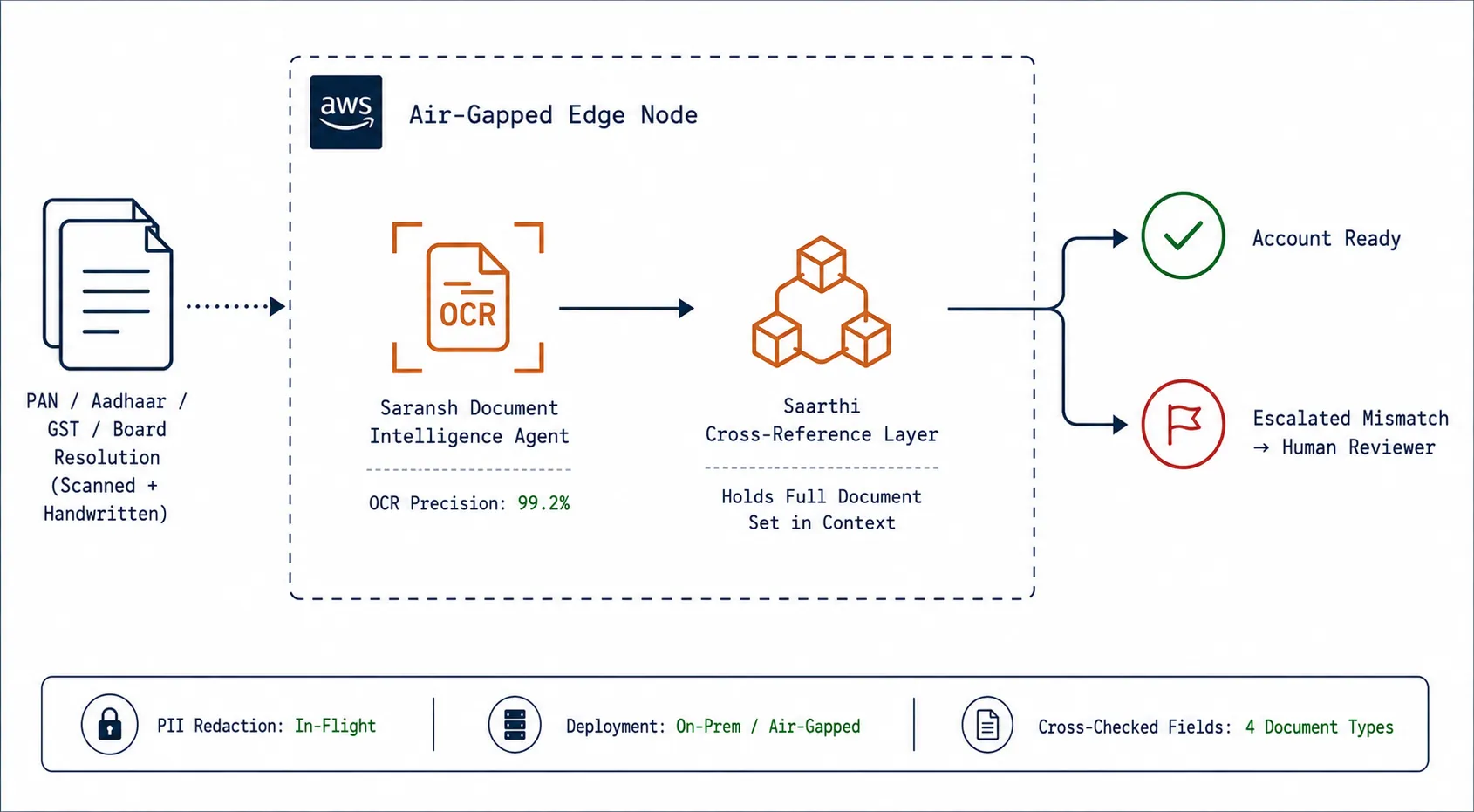
The Saransh Document Intelligence Agent classifies each uploaded document by type, extracts the relevant fields using OCR trained specifically on regional scripts and handwriting, and redacts PII in flight before anything downstream sees it. A Saarthi orchestration layer then does the part that actually matters: it cross-references the extracted fields across the whole document set — does the PAN on the form match the PAN card, do the director names on the board resolution match Aadhaar — and only escalates genuine mismatches to a human reviewer, not every document.
That cross-referencing step is why this needs to be agentic rather than a per-document OCR pipeline. A stateless pipeline processes each document in isolation and discards what it saw the moment the next file loads — it has no way to carry the director's name from the board resolution forward to the moment it's checking the Aadhaar copy three documents later. The agent keeps the whole application's extracted state in context across the entire set, so by the time it reaches document nine it still remembers exactly what documents three and five said, and can decide what's actually worth flagging.
What This Pattern Typically Delivers
Reviewers see a short list of genuine mismatches instead of re-checking every field on every document. Aged scans, handwritten annexures, and regional-language documents that would trip up a generic OCR tool still get classified and extracted correctly, because Saransh's vision models are trained specifically for that case rather than adapted from an English-first pipeline.
Every document stays inside the bank's own infrastructure — Saransh is designed to run air-gapped, so nothing about this depends on customer documents leaving the bank's environment.